

How To Install Sql Reporting Services 2017
This browser is no longer supported.
Upgrade to Microsoft Edge to take advantage of the latest features, security updates, and technical support.
Install SQL Server Reporting Services
APPLIES TO: ✔️ SQL Server Reporting Services (2017 and later) ❌ Ability BI Study Server
SQL Server Reporting Services installation involves server components for storing written report items, rendering reports, and processing of subscription and other study services.
Before you brainstorm
Before y'all install Reporting Services, review the Hardware and software requirements for installing SQL Server.
Install your study server
Installing a report server is straightforward. There are only a few steps to install the files.
Notation
You do not demand a SQL Server Database Engine server available at the fourth dimension of install. You volition need one to configure Reporting Services after install.
-
Notice the location of SQLServerReportingServices.exe and launch the installer.
-
Select Install Reporting Services.
-
Choose an edition to install and and so select Next.
For a free edition, choose either Evaluation or Developer from the driblet down.
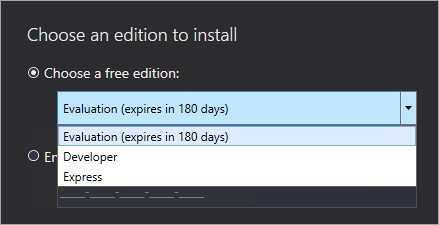
Otherwise, enter a product key. Find the production key for SQL Server Reporting Services.
-
Read and agree to the license terms and conditions and and so select Next.
-
You need to have a Database Engine bachelor to store the report server database. Select Next to install the report server simply.
-
Specify the install location for the report server. Select Install to continue.
Note
The default path is C:\Program Files\Microsoft SQL Server Reporting Services.
-
Subsequently a successful setup, select Configure Written report Server to launch the Report Server Configuration Manager.
Configure your report server
After you select Configure Report Server in the setup, y'all will exist presented with Report Server Configuration Manager. For more information, come across Report Server Configuration Director.
You need to create a report server database to complete the initial configuration of Reporting Services. A SQL Server Database server is required to complete this step.
Creating a database on a different server
If you are creating the study server database on a database server on a different machine, y'all need to change the service business relationship for the report server to a credential that is recognized on the database server.
Past default, the report server uses the virtual service account. If you try to create a database on a different server, yous may receive the following error on the Applying connection rights step.
Organization.Information.SqlClient.SqlException (0x80131904): Windows NT user or group '(null)' not found. Check the name over again.
To piece of work around the mistake, you can modify the service business relationship to either Network Service or a domain account. Changing the service account to Network Service applies rights in the context of the machine account for the report server.
For more information, run across Configure the written report server service account.
Windows Service
A Windows service is created as part of the installation. It is displayed as SQL Server Reporting Services. The service name is SQLServerReportingServices.
Default URL reservations
URL reservations are composed of a prefix, host name, port, and virtual directory:
| Part | Description |
|---|---|
| Prefix | The default prefix is HTTP. If you lot previously installed a Transport Layer Security (TLS), previously known equally Secure Sockets Layer (SSL), certificate, Setup tries to create URL reservations that use the HTTPS prefix. |
| Host name | The default host name is a strong wildcard (+). It specifies that the report server accepts any HTTP request on the designated port for whatever host name that resolves to the computer, including https://<computername>/reportserver, https://localhost/reportserver, or https://<IPAddress>/reportserver. |
| Port | The default port is eighty. If y'all use any port other than port fourscore, you lot take to explicitly add it to the URL when you open web portal in a browser window. |
| Virtual directory | By default, virtual directories are created in the format of ReportServer for the Written report Server Web service and Reports for the web portal. For the Written report Server Web service, the default virtual directory is reportserver. For the web portal, the default virtual directory is reports. |
An example of the complete URL string might be every bit follows:
-
https://+:80/reportserver, provides access to the report server. -
https://+:80/reports, provides admission to the web portal.
Firewall
If you are accessing the report server from a remote car, you want to brand certain y'all have configured whatever firewall rules if at that place is a firewall nowadays.
Yous need to open up the TCP port that y'all have configured for your Web Service URL and Web Portal URL. By default, these are configured on TCP port 80.
Additional configuration
-
To configure integration with the Power BI service so you can pin written report items to a Power BI dashboard, see Integrate with the Power BI service.
-
To configure email for subscriptions processing, see East-Mail settings and E-mail delivery in a report server.
-
To configure the spider web portal and then you can access it on a remote reckoner to view and manage reports, run into Configure a firewall for written report server access and Configure a report server for remote assistants.
For information on how to install SQL Server Reporting Services native manner, see Install Reporting Services native mode report server.
Next steps
With your study server installed, begin to create reports and deploy those to your report server. For information on how to start with Report Builder, come across Install Report Builder.
To create reports using SQL Server Information Tools, download SQL Server Data Tools.
More questions? Try asking the Reporting Services forum

Source: https://docs.microsoft.com/en-us/sql/reporting-services/install-windows/install-reporting-services
Posted by: olivenonvize.blogspot.com
0 Response to "How To Install Sql Reporting Services 2017"
Post a Comment